

“The creative is the place where no one else has ever been. You have to leave the city of your comfort and go into the wilderness of your intuition. What you’ll discover will be wonderful. What you’ll discover is yourself.” — Alan Alda
A version of this post was originally shared at Kiwi Crate.
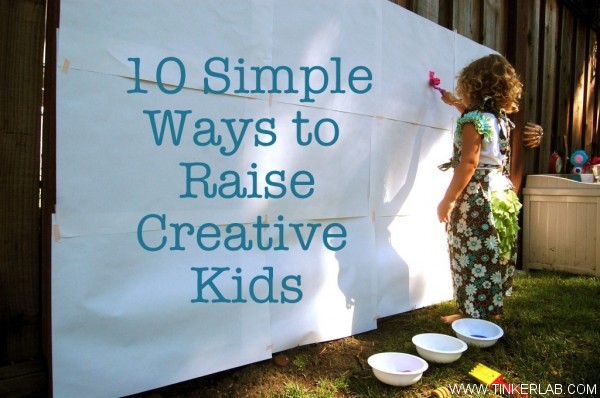
Are you interested in raising your child to be their most creative self? The path to creative thinking isn’t a direct on, but there are a few landmarks that can help us find our way.
Here are 10 ways to raise creative children:
1. Make Mistakes
Stanford researcher and author of Mindset: The New Psychology of Success, Carol Dweck, shares that children who are afraid of failure are less likely to think creatively. If your child acts disappointed at making a mistake, try saying something like, “what can we do to change this outcome?” or “how could you do this again?” I like how my friend and colleague Ben Grossman-Kahn of The Nordstrom Innovation Lab calls this Failing Forward, or looking at mistakes as opportunities for growth rather than failures.
2. Get Messy
Most of us like a clean space and feel overwhelmed when messes get out-of-hand. However, when children are in their creative element, messes can quickly develop. The next time your child asks to paint or wants to dump a bag of cotton balls all over the floor, make room for it (and/or take it outside). You might have to contend with a mess, but the creative benefits will surpass this temporary inconvenience.
3. Offer Praise for Effort
We’ve all heard a lot about how praise can hinder a child’s independent thinking. In Alfie Kohn’s book, Punished by Rewards: The Trouble with Gold Stars, Incentive Plans, A’s, Praise, and Other Bribes, he talks about how rewards succeed at motivating people to….earn more rewards. The problem with praise is that it can strip a child from searching for his own internal motivations. This isn’t to say that all praise is bad, but next time you’re tempted to praise, try saying something objective such as, “I see that you put your shoes on by yourself,” or “You’re working really hard on that math problem.”
4. Be open-minded
Offer your child choices as a way to encourage independent thinking. You may not be in the habit of eating dinner for breakfast, but if your child says she wants to eat pasta before heading off to school, make room for that. If she wants to help in the kitchen, try turning your kitchen into a science lab and give her open access to a handful of ingredients and kitchen tools.
5. Model Creativity
What’s your creative outlet? Where do you enjoy putting your creative energy? Cooking, singing, gardening, drawing, dancing? Children who watch their parents engage in creative activities are more likely to embrace these activities themselves. If it’s been a while since you’ve done something creative, think about what made you happy in your own childhood and spend half an hour doing that activity with your child. How did it feel? Could you try it again tomorrow? And the next day?
6. Step Back
This may seem to contradict #5 a bit, but it’s important to remember that this is all about striking a balance. If a child feels like she’s constantly under surveillance, she may be less likely to take risks, which would diminish her creativity. If you encourage autonomy, you’ll see your child’s imagination bloom. The next time your child is engaged in quiet play, drawing, or writing, refrain from jumping in with a comment like “what are you drawing?” This will only pull him out the zone. Instead, make yourself a cup of coffee and enjoy a moment to yourself!
7. Set aside creativity time
This can be hard, especially for working parents, but children need unstructured time to imagine, build, experiment, and explore. It could be half an hour after dinner, drawing time in bed before reading a book, or an hour of imaginative play every weekend. Look at your schedule and make sure that there’s time set aside for this.
8. Get Back to the Basics
Toys that beep and flash are fun, and definitely have their place, but they don’t build creative thinkers the way sticks, tubes, blocks, dolls, office supplies, sand, and water do. Spend some time watching your child play and take a quick inventory of your toys. What do they play with the most? What objects do they pull into imaginative play? Can you swap a close-ended toy (for example, a toy with buttons that has one or two functions) with an open-ended toy (like blocks that encourage free play)? This post by Amy Anderson for SimpleKids is full of great ideas: Creative Pretend Play Props and Ideas
9. Minimize Screen Time
It can be hard for some families to remove screen time altogether, but we can all make an effort to spend less time in front of the screen. Time spent watching videos or cartoons could be spent drawing, building a city out of blocks, or serving up play dough cupcakes. What could you do to reduce screen time?
10. What other ideas do you have for raising creative kids?
There are so many ways to encourage a child’s creativity, and I’d love to hear what works for YOU! What would you add as the #10 way to raise creative kids?

Great quote find! I love it 🙂
Thanks, Kristin.
HelloÂ
Love your posto very Inspiring!! Just a question, why does it say on your list not to praise?Â
But I must say that I am a big fan of your excellent blog! Love it!Â
martha BernhardÂ
Hi Martha,
The idea here is to praise less, and be thoughtful about how and when we praise. In response to another comment about this point, I rephrased the text and hope this clarifies it a bit. Let me know! And thank you for the sweet comment. I look forward to your comments and I’m so glad you’re here!
Rachelle
I like thinking about ways to raise creative kids. I would add to the list something about creativity (in its widest sense) being innate in young children, and how it’s about trying not putting a stopper on it as a parent.Â
Also, recently I’ve been thinking about how young children play creatively using what us grown ups might call Improv techniques (yes, I’ve just read Tina Fey’s book Bossypants). Young children are very ‘at home’ to saying ‘yes’ to ideas. And then adding the…. ‘and’ – thus developing a creative idea.
This is great, Julia. I’m a big fan of improv as well, and it’s surprising how often we hear “yes, but…” Saying “Yes, and…” is so generative and exciting, and a wonderful tool for adults who want to find an easy entry-point into playing with little kids. And I have yet to ready Bossypants — I must be the last one — I’m adding it to my reading list!
*trying not to put a stopper on it* I mean. It’s been a long day. Sorry.
I really don’t understand the “don’t praise” one. Â I don’t get that at all. I don’t think it hinders your child to say “What a great drawing!” or “You’re riding your bicycle really well!” Â How robotic do you sound if you say “objective” things all the time? “I see you painted your tree green…how interesting.” Â “you’re working really hard to move your feet in an up and down motion to propel the bike forward.” Â Oh give me a break! Â You just sound like an asshole. Â If someone got objective talk from their peers or boss at work I doubt that they would be more motivated to do something more or better. Â Praise is not a bad thing. Â I get that you don’t HAVE to praise your child for menial tasks…but when they learn something new or try something new…I think it helps encourage them.
Hi Lani, Your comment has been sitting with me all day and I want you to know how much I appreciate hearing different voices in these conversations. For me, the idea is to be thoughtful about how and when we praise. Just this afternoon I said “great job” to my one year old as she went down the slide by herself, so clearly a path of no praise is not what I’m after. In my book, some praise is fine, and maybe the bigger point is to find ways that we can encourage internal motivation, which could be accomplished in multiple ways: making objective comments, asking open-ended questions, helping children make their ideas a reality, etc.
I think you make a good point (and the last thing I’d want to sound like is an asshole!)Â and I changed the words to qualify this statement a bit (from “Don’t Praise” to “Be Mindful of When You Praise.”) I’d love to hear your thoughts. ~Rachelle
I think there’s also research that praising children for being “smart” or for the product produced can actually make them anxious about having to constantly fulfill that designation. I think it is okay to praise the process instead: i.e., “I love how hard you are working on that painting” instead of “Your painting is so beautiful.” That way too you can always give them praise that is genuine rather than having to compliment their stick figure drawing of an alien.
My 12 year old came up to me last year to tell me he wanted to quit basketball, the sport he had been practicing with a jr team for 5 years. It was a no stress/no competition, just get some exercise and have fun sorta thing for kids, and when I asked him the reason, he said “you lied to me all these years about being good at it. I’m not. I can see that. So I don’t want to spend more time trying to get better, because I’m not talented like that.”
Just for putting his feelings together I should have praised him, instead I looked back at all those missed shots, all those times when he was the first kid ruled out in a knock-out kinda exercise, etc etc and told him that I thought he was good at it, and he could still be good at it with more practice. “Come on, mom, 5 years?” And when given the example of years and years of practicing for perfect, he said, “I don’t want to be perfect, I can play with my friends, I know enough.”
So that’s where we should dose the praise – I love what Meryl suggests – praise the process so you don’t get blamed by your child in the future 🙂
Oh Rachelle…I’m sorry….I didn’t mean to come off sounding like I was calling YOU an asshole personally. Â That was wrong of me. Â I just meant that objective phrases can make someone, anyone, Â just sound like a jerk. Â I agree to a certain extent that you shouldn’t praise mediocrity. Â Example…my 3 year old played soccer in the fall….and stunk. Â Up to high heaven. Â It wasn’t even a “game” but more like a class…but he was the kid who sat in the middle of the field and didn’t want to participate in the least. But he gradually improved over the 12 weeks and every time he ATTEMPTED to kick the ball I wanted him to know that I thought he was doing a GREAT JOB at TRYING. Â I never said “Wow you’re totally awesome at soccer!” Â I always praised him for the effort that he was putting into the class every week. Â “I’m really proud of you that you played red light green light this week. Â Maybe next week we’ll do that AND simon says!”….or whatever. Â And at the end of the season…he got a trophy. Â I wan’t overly thrilled with that notion…but he was OVER THE MOON about it. Â So….I told him “Do you know why you got a trophy? Because you worked really hard and something and improved. Â You don’t get a trophy just for showing up. Â You got it because you worked at it.” Â I know I sound like a harsh mom to some…but I believe that praising the EFFORT is way more important that false praise like “wow..you’re so good at X-Y-Z….”. Â I do appreciate your points…it’s always good to hear from others in order to improve yourself. Â Again I’m sorry for coming off as..you know…THAT commenter. Â I just love my kids to death and I think that praise, when placed in the right setting (which is what you are saying, now I see that) encourages them, and I always see an improvement in whatever they do when I praise their efforts…
I’m so glad you came back to share this story, Lani. You don’t sound like a harsh mom at all — the opposite in fact. You sound like a thoughtful and compassionate mom, who’s helping her kids be their very best selves. And you raise another good point that I failed to mention (this is the trouble with a list like this that doesn’t dig especially deep): praising EFFORT is very different from praising accomplishment. And clearly it works! I learn so much from this blog and really appreciate your input.Â
Hey I really like this list! Could your next list be how to raise creative kids with husbands who hate mess.
Ha! Yes, I’ll work on that!Â
Ok, so I’ve heard that you shouldn’t give praise before. I’m wondering what the thinking is behind this and what words are considered praise. How should the conversation go?
Good question. Here’s what I shared in the Kiwi Crate post. Does this help?:
We’ve all heard a lot about how praise can hinder a child’s independent thinking. In Alfie Kohn’s book, Punished by Rewards: The Trouble with Gold Stars, Incentive Plans, A’s, Praise, and Other Bribes, he talks about how rewards succeed at motivating people to….earn more rewards. The problem with praise is that it can strip a child from searching for his own internal motivations. This isn’t to say that all praise is bad, but next time you’re tempted to praise, try saying something objective such as, “I see that you put your shoes on by yourself,” or “You’re working really hard on that math problem.”
Great list. I agree with the one about mess! I’d also add embracing the process and not the product – I think that can be hard to do for us adults — see our experiments with cloud/rain dough.
http://outdoorsparent.com/2012/03/02/rain-dough-or-embrace-the-process/
Thanks for sharing the link. It can be so eye-opening to see where kids’ ideas can take a project. It can be tempting to curb their ideas when we think we know the outcome, but this is a great reminder that we don’t always know…
I will certainly keep these wise words in mind :0)Â
Hi Rachelle! I liked your list and can see the point you are trying to make with the be mindful of when you praise or even how you praise. As a parent (for me personally) I struggle with this, as I find myself praising my 20mo for everything. I guess I want him to feel loved and encouraged however sometimes I may do the opposite-as he receives the praise he feels as if he doesn’t have to do any more therefore hindering a higher potential.
Can I also say that I love your blog! Each week I feel inspired to do a few of these fun activities with my baby boy, thanks a million!!!
Thanks for sharing your personal struggle with this praise/no praise tension. As I’ve been thinking about it more over the past few days I think it’s important for parents to recognize the power that praise can hold over a child. Having an awareness of it can help us use it more appropriately. Â And thank you for the great vote of confidence! It’s so nice for me to hear that my words and ideas are doing a bit of good for the world. xo
This is a great list, Rachelle! Being mindful of praise is harder to do than you’d think! I want to gush at every little thing…my kids just fascinate me. 🙂
I want to gush, too, Tricia. It helps to laugh a lot and join them in their enthusiasm and efforts (and I know you do all these things). The other day a friend was telling me that her husband praised their daughter’s singing ability in front of a group of people, and she stopped singing! Praise effort rather than accomplishments, and you’ll feel the difference.
My heart resonated with ZYMZYM’s story: she had told her son for 5 years that he was good at his sport and finally he said, “No, I’m not.” My daughter Jenny, now 29, grew up in a soccer town and the high school team was nationally ranked. She was seriously good as a youngster, but had physical issues that kept her on the sidelines for a whole season; she went to every practice, every game, unable to play.
The next year, when it was time to go to 3-a-days, she told me, “I just don’t think I can do this again, Mom.” I replied, “Jenny, you don’t have to. But I believe in you. Go put on your clothes and then see how you feel about it.” So she did. “Now go put on your shinguards and socks and Adidas and see how you feel about it.” She did that. “I’ve packed your water and your lunch. How about we drive over to the field? You don’t have to get out of the car unless you want to.” So we did that. We sat there for a minute. Then she turned and smiled at me, gave me a hug and a kiss and ran to the field.
She made varsity and her team was ranked 4th in the nation that year, her junior year.
I have left out the part about both of us yelling and crying (“I can’t! I can’t” “yes you CAN! YOU CAN!”) I also left out the part about her senior year, which was a catastrophe, and how she looked into colleges where she could play soccer, then did a U-turn and majored in fashion design. For a while she would roll her eyes when I mentioned soccer.
Now she is almost 30 years old and a fashion designer in NYC where she loves her life. Her soccer experiences are once again applicable, in that she is irrepressible and can deal with set-backs and U-turns.
Not only that, she is designing soccer uniforms and blows people’s minds when she slips off her heels and uncontrollably runs onto the field to juggle and head a ball!
Being willing to try, to keep trying, and to change directions when you must is a critical life skill which is fostered in childhood.
I close with one of my favorite Jenny stories.
A few years back Jenny was doing socks and had a college intern working with her. The intern was excited to show Jenny the designs she did and Jenny praised her work: 25 different socks. “But how many did you do?” the intern asked, seeing the stacks and stacks of illustrations. “134,” Jenny answered. “But don’t try this at home. I’m a professional.”
🙂
We’re trying to raise creative kids by challenging their little minds and giving them creative challenges.
(www.outnumbered.be/craft-creativity/draw-something-that-does-not-exist/)
[…] https://tinkerlab.com/10-simple-ways-to-raise-creative-kids/ […]
[…] Comes with suggestions for four layouts but you and your child can design many more by engaging creativity […]